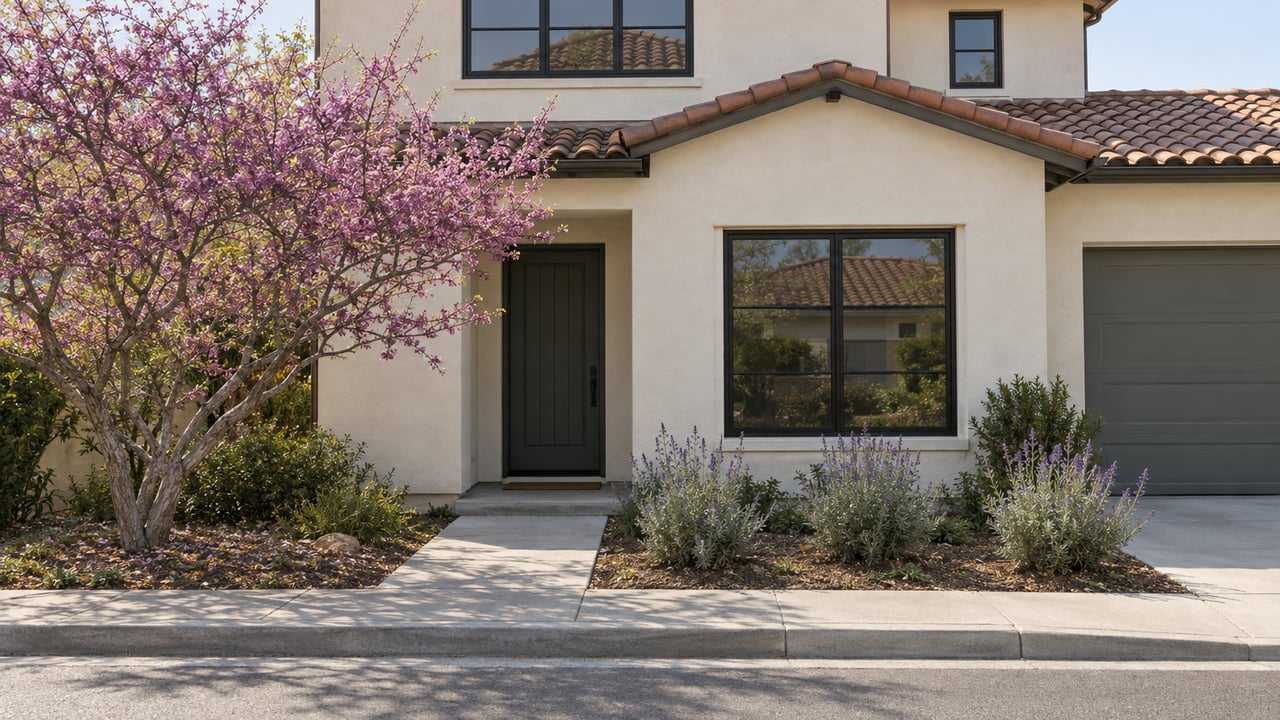
A three-bedroom townhome in RiverPark and a three-bedroom house in an older Oxnard neighborhood can carry almost identical price tags and still cost a buyer very different amounts every month. That gap doesn't show up on the listing sheet. It shows up on the county tax bill, in a line most buyers don't read until after they've already made an offer.
RiverPark's own neighborhood median sold price ran $656,668 as of May 2026, according to Redfin, up 2.7 percent year over year. Oxnard's citywide median sold price over the six months ending in August 2026 was $770,000, per Resideline's Market Watch data updated that September. RiverPark, one of the newest, most amenity-dense master-planned communities in the city, is trading roughly 15 percent below the broader Oxnard number. That's the opposite of what new construction with a retail hub, trails, and community parks usually commands.
The special tax on the RiverPark tax bill is not the only reason for that gap, but it's the one most buyers overlook, and it's the one that behaves very differently depending on which Oxnard neighborhood you're comparing it to.
What the Levy Actually Pays For
RiverPark's Community Facilities District No. 5 was established in 2005 to fund community-level services the city doesn't cover out of its general fund: park and open-space maintenance, sports field upkeep, flood and storm protection, and supplemental police patrols. Campaign materials from the 2024 ballot fight put a number on what that buys day to day: RiverPark maintains 702 acres of shared open space and roughly 5,200 trees, with about 1,700 pruned on a regular schedule, plus playgrounds and sports fields serviced seven days a week. The Central Park fountain, the one that anchors the retail corridor at The Collection at RiverPark, is part of that same maintenance budget.
The tax that pays for it isn't fixed at the legal ceiling. The city applies assessments at a percentage of the maximum allowable rate set back in the 2005/2006 base year, and that applied rate has historically run below the cap, around 64 percent of it in recent years. The ceiling itself climbs by about 2 percent annually, the same kind of escalator that shows up across Oxnard's other special tax districts. That headroom matters for a buyer thinking about a five- or ten-year hold: the number on this year's bill is not necessarily the number you'll see in year seven.
The Vote That Was Supposed to Settle It
For most of 2024, whether that tax would even survive was an open question. Two RiverPark residents, Aaron Starr and Alicia Percell, qualified three citizen initiatives for the November 5, 2024 ballot aimed at repealing or shrinking the district's special tax. Measure J would have eliminated CFD No. 5 outright. Measure K would have cut the maximum tax rate in half. Measure L would have restricted how the money already being collected could be spent, barring it from funding the youth sports fields and gymnasium, among other uses.
The city commissioned an independent fiscal review from Russ Branson Consulting before the vote. That report estimated Measure K alone would force a budget reduction of about $1 million for fiscal year 2025/26, a 23 percent cut to the district's spending, because Oxnard's own ordinance prohibits the city from using general fund money to backfill a CFD shortfall once residents vote to reduce it. In response, the City Council placed a fourth measure, Measure I, on the same ballot to reaffirm the existing funding structure without raising it.
A resident group called Protect RiverPark organized around Measure I, framing the stakes bluntly in campaign material:
"It's not just about saving money; it's about preserving the community we love and ensuring it remains a safe, welcoming place for our families."
Voters agreed by a wide margin. Certified results released by the Ventura County Elections Division showed Measures J, K, and L each drawing less than 35 percent support, while Measure I passed with 76 percent of the vote. RiverPark's special tax structure, and the services it funds, stayed exactly where it was before the ballot fight started. The city held community meetings at El Rio Middle School in the run-up to the election to walk residents through what each measure would and wouldn't change.
For a buyer evaluating a RiverPark listing today, that election result is closer to a stress test than a footnote. A community-wide vote on whether to keep this tax already happened, and the answer was a decisive yes.
Why the Math Doesn't Match the Address
This is where the price gap starts to make sense. A recurring monthly obligation, whether it's an HOA due or a Mello-Roos line, counts against a buyer's debt-to-income ratio the same way a car payment does. RiverPark's special tax typically adds somewhere in the range of $100 to $150 a month or more on top of principal, interest, insurance, and any HOA dues, and because the tax rides on the county property tax bill rather than a separate invoice, it's easy to compare two RiverPark listings, see similar HOA numbers, and assume the total carrying cost is the same. It isn't, if the CFD amount differs by lot size or phase.
That recurring cost has to come from somewhere in a buyer's budget, which means it gets priced into what buyers are willing to offer. A permanent, voter-reaffirmed special tax is exactly the kind of recurring cost that shows up as a lower purchase price rather than a separate line item, because the total monthly number is what a lender, and a buyer, actually cares about. RiverPark's amenities didn't get cheaper. The all-in cost of owning there is spread across two numbers instead of one, and only one of those numbers is visible on a listing sheet.
RiverPark Isn't Oxnard's Only Special Tax Neighborhood
The mistake worth avoiding is treating "does this house have Mello-Roos" as a yes-or-no question. Oxnard has multiple community facilities districts, and they don't age the same way.
| District | Neighborhood | Structure | Expected end |
|---|---|---|---|
| CFD No. 5 | RiverPark | Non-bonded, funds ongoing services | No expiration by design |
| CFD No. 3 | Seabridge at Mandalay Bay | Bonded, 2013 bonds | Special tax not expected to levy past FY 2034/35 |
| CFD No. 4 | Seabridge at Mandalay Bay | Non-bonded, funds ongoing services | No expiration by design |
| CFD No. 1 | Westport at Mandalay Bay | Bonded, 2022 refunding bonds | Special tax not expected to levy past FY 2031/32 |
| CFD No. 2 | Westport at Mandalay Bay | Non-bonded, funds ongoing services | Established 2000 |
Seabridge is the clearest case of stacking. CFD No. 3 and CFD No. 4 directly overlap the same parcels, one paying off a bond that's set to mature in 2035, the other funding channel maintenance, police protection, and open space in perpetuity. The city's own material notes that even the tennis courts near the neighborhood's grocery anchor fall inside a Seabridge CFD boundary. A buyer looking at a Seabridge listing today could be paying both taxes at once, and only one of them goes away.
Westport's bonded district is scheduled to stop levying within the next several years, which means a Westport buyer's total carrying cost is on a downward path that a RiverPark buyer's is not. None of this makes one neighborhood a better or worse choice. It means the same phrase, "Mello-Roos community," describes three different financial timelines depending on which side of the 101 the address sits on.
Reading the Bill Before You Write the Offer
The number on a listing sheet is an estimate. The number that matters is on the current property tax bill for that specific parcel, because Mello-Roos assessments vary by land use class, lot size, and phase even within the same development. Oxnard's Public Works Department maintains an interactive map that lets a buyer look up whether a specific address sits inside a special financing district before making an offer.
Once you have the actual annual figure, divide it by twelve to get a monthly number, add it to principal, interest, insurance, and HOA dues, and compare that total across every property on your list, not just the sticker price. Ask the seller's agent whether the district attached to the home is bonded or non-bonded, and if it's bonded, ask when the bonds mature. That answer tells you whether the monthly number you're budgeting for today is temporary or permanent.
Does a Mello-Roos tax ever go away on its own? Only if it's tied to a bonded district with a maturity date, like Westport's CFD No. 1 or Seabridge's CFD No. 3. Non-bonded districts that fund ongoing services, like RiverPark's CFD No. 5 or Seabridge's CFD No. 4, are built to continue indefinitely unless voters act to end them, which RiverPark residents declined to do in 2024.
Is Mello-Roos the same thing as HOA dues? No. HOA dues are a private assessment paid to a homeowners association. A Mello-Roos tax is a public special tax administered by a government district and typically appears on the county property tax bill itself, alongside the base 1 percent rate set under Proposition 13.
Does the CFD amount affect what I can get approved for? Yes. Lenders include the special tax in the same debt-to-income calculation as your base property tax, so a higher CFD line reduces the loan amount you'll qualify for, all else equal.
A listing price only tells you what a home costs to buy. In Oxnard's Mello-Roos neighborhoods, the tax bill tells you what it costs to keep. If you're comparing RiverPark against Seabridge, Westport, or a non-CFD Oxnard neighborhood and want help pulling the actual numbers before you write an offer, Truth Realty can walk through the parcel-specific tax history with you and help you weigh the total cost, not just the price on the sign.